Guide
Demystifying the RTI Schedule: A Beginner's Guide to How Schools Support Every Student
Imagine a classroom with 30 students. Some grasp a new math concept instantly, while others need a bit more time. A few might be completely lost and require significant, individualized help to catch up. How does a school ensure that the advanced students stay challenged, while the struggling students get the exact help they need—without anyone missing out on regular class time?
This logistical puzzle is solved using an RTI Schedule.
If you are outside the education field, "RTI" might sound like confusing jargon. However, it is actually one of the most important frameworks used in modern schools to ensure no child falls through the cracks. Here is a simple breakdown of what an RTI schedule is, how it works, and why it matters.
What is RTI?
RTI stands for Response to Intervention. It is a proactive, data-driven approach used by educators to identify students who are struggling with academics (like reading or math) or behavior, and provide them with targeted support before they fall too far behind.
Instead of waiting for a student to fail an exam to realize they need help, teachers use the RTI framework to constantly monitor progress and intervene early.
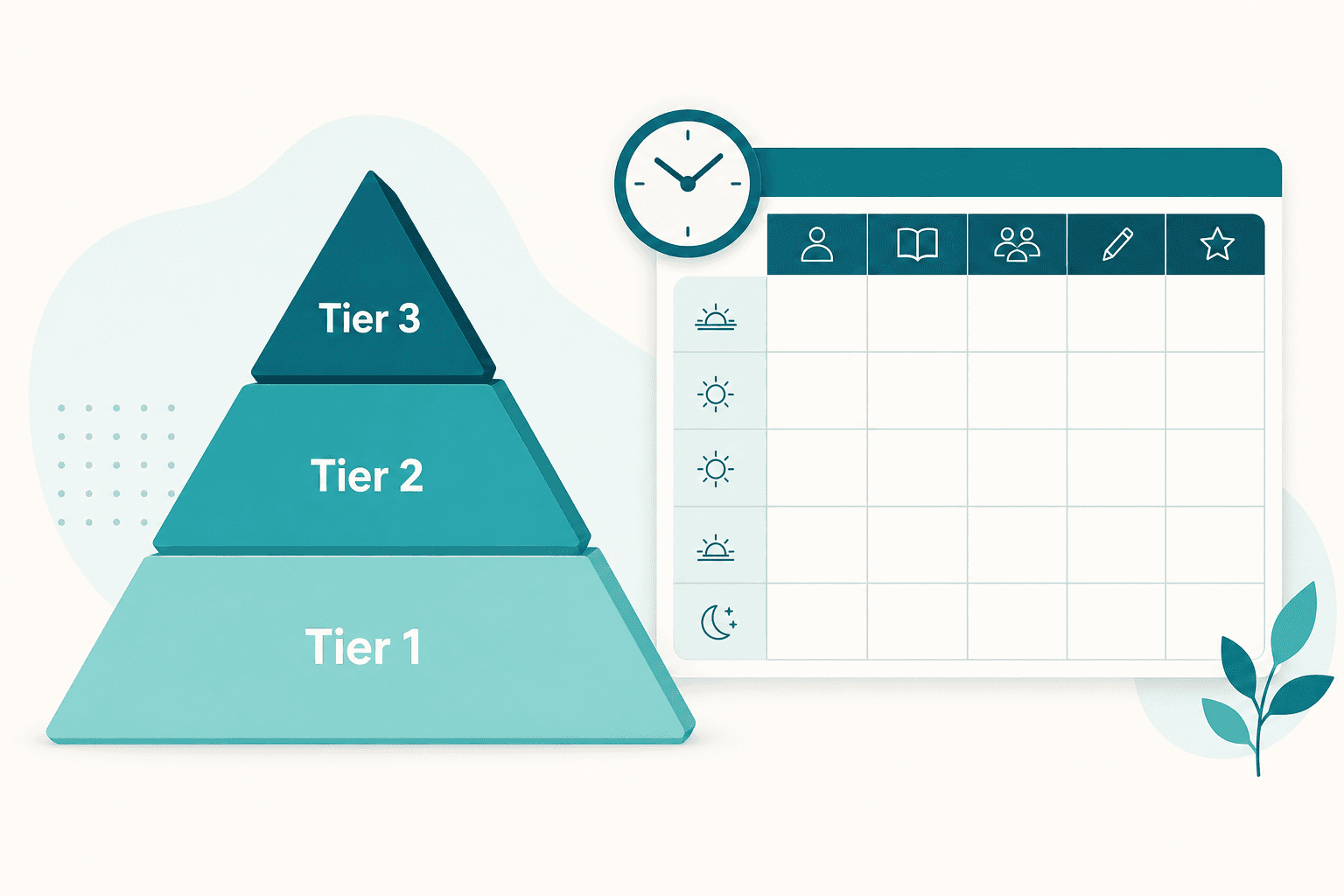
The RTI model is built on a pyramid of three "Tiers":
- Tier 1 (Core Instruction — The Whole Class): This is the foundation. Every single student receives high-quality, general instruction in the main classroom. (About 80% of students will succeed with just Tier 1).
- Tier 2 (Targeted Support — Small Groups): Students who are struggling with Tier 1 instruction are placed in small groups for extra, targeted help. (About 15% of students need this).
- Tier 3 (Intensive Support — Individualized): Students who do not make progress in Tier 2 receive highly customized, intensive, and often one-on-one instruction. (About 5% of students need this).
So, What is an "RTI Schedule"?
Having a philosophy like RTI is great, but executing it is incredibly difficult.
An RTI Schedule is the actual, logistical blueprint of the school day. It dictates exactly when and where Tier 2 and Tier 3 interventions happen.
Creating this schedule is often the hardest part of a school administrator's job because of one golden rule in education: A student cannot miss core instruction (Tier 1) to receive intervention (Tier 2 or 3). If a student is pulled out of their regular math class to get extra math help, they are just going to fall further behind in what the rest of the class is learning that day.
How Does an RTI Schedule Work in Practice?
To solve this puzzle, schools have to get creative with time. Here are the most common ways schools build an RTI schedule:
1. Dedicated intervention block (WIN time)
Many schools create a specific 30- to 45-minute block every day where no new, core instruction is taught. Schools often call this WIN time ("What I Need").
- During WIN time, the entire school pauses regular classes.
- Students who need Tier 2 or Tier 3 help go to specialized rooms with intervention teachers.
- Students who do not need extra help stay for enrichment, silent reading, or advanced projects.
Because no new material is introduced during this block, nobody misses out.
2. Push-in model
Instead of pulling students out, an RTI schedule might bring a second teacher (intervention specialist) into the main classroom. The main teacher manages the bulk of the class while the specialist works with a small Tier 2 group at the edge of the room.
3. Station rotation
Within a 90-minute reading block, teachers schedule multiple "stations." Tier 2 intervention happens in one station while the rest of the class rotates through independent work and collaborative tasks—keeping everyone productive.
Why the RTI Schedule is So Important
Without a rigid and well-thought-out RTI schedule, interventions happen haphazardly. A teacher might try to help during recess or briefly after school, which isn't consistent or fair to the student.
A strong RTI schedule ensures that:
Support is guaranteed
Interventions are baked into the school day—not an afterthought.
Data drives decisions
Dedicated windows let teachers reassess frequently and adjust Tier placement based on performance.
Resources are maximized
Coaches reach the students who need them most at predictable, protected times.